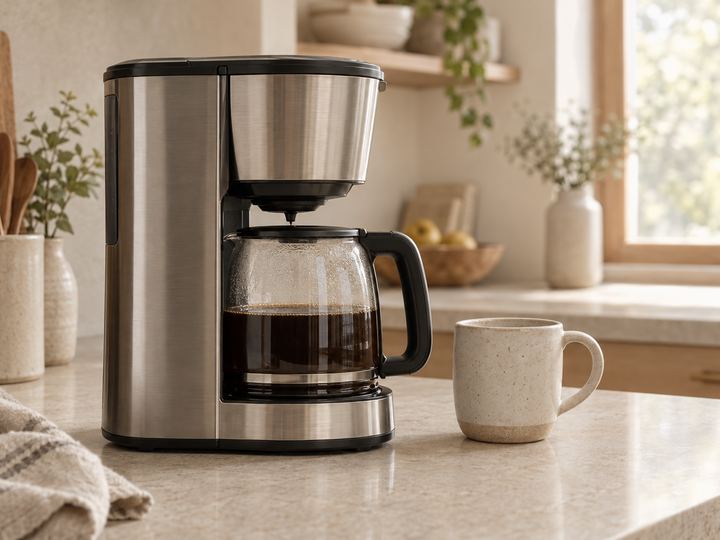
A shiny stainless-steel coffee maker is not necessarily plastic-free. The outside may be metal while the water reservoir, showerhead, filter basket or internal tubing contains plastic. That is why the best plastic-free coffee maker is not simply the most metallic-looking machine: it is the brewer whose actual coffee and hot-water contact surfaces suit your priorities.
If avoiding hot-water contact with plastic comes first, manual brewers are generally easier to evaluate than automatic drip machines. They have fewer hidden parts and make it possible to see exactly where the water goes.
Our shortlist at a glance
| Coffee maker | Best for | Main brewing materials | Important caveat |
|---|---|---|---|
| Chemex Classic | Smooth, paper-filtered coffee | Glass and paper | Requires a kettle and specialty filters |
| Chemex Glass Handle | Minimal-contact glass setup | Glass and paper | Handle gets more attention when hot |
| Hario V60 Ceramic | Single-cup pour-over control | Ceramic and paper | Fragile and technique-sensitive |
| Kalita Wave Stainless Steel | Forgiving pour-over | Stainless steel and paper | Check your chosen model and filter size |
| Melitta Porcelain Dripper | Simple, budget-friendly manual brewing | Porcelain and paper | Availability varies by market |
| Frieling Stainless Steel French Press | Full-bodied coffee | Stainless-steel vessel and mesh | Verify the exact plunger assembly |
| Bialetti Venus | Strong stovetop coffee | Stainless-steel body | Contains gasket and other components; not wholly plastic-free |
| AeroPress Steel | Fast single servings | Stainless-steel body | Has a silicone seal |
| ESPRO P7 | Filtered French press | Stainless-steel body and mesh | Filter includes a polypropylene cage and silicone seal |
| Moccamaster | Automatic convenience | Mixed materials | Uses plastic in coffee/water-contact components |
This is a materials-and-use-case shortlist, not a claim that all ten products are entirely free of plastic. The last two are especially useful comparisons for buyers deciding where to compromise.
Best for clean-tasting pour-over: Chemex Classic
The Chemex combines a borosilicate-glass brewer with a paper filter. Hot water goes through coffee and paper into glass, rather than through a plastic filter basket. Its thicker proprietary filters tend to produce a relatively clear cup with less sediment than metal-filter methods.
The downsides are modest but real: glass can break, the brewer is not automatic, and filters are a recurring purchase. If those trade-offs work for you, explore the Chemex Classic coffee maker.
Best for single cups: Hario V60 Ceramic
A ceramic V60 is an excellent choice for people who brew one or two cups and enjoy adjusting grind size, pour speed and water temperature. The coffee contacts a paper filter and ceramic dripper. It works particularly well with a gooseneck kettle, although a normal kettle can work with practice.
Choose a size that matches your daily dose and compare ceramic V60 drippers before buying.
Best for a richer cup: Stainless-steel French press
French presses use immersion brewing rather than passing water through paper. A well-designed stainless-steel press can reduce glass breakage and keep coffee warm longer. However, do not assume that every lid, gasket or filter assembly is metal. Inspect the specific press rather than relying on the words “stainless steel.” See stainless-steel French press options.
Best for automatic brewing: A carefully evaluated drip machine
If waking up to a ready pot matters most, convenience may justify some food-contact plastic. For example, Moccamaster explicitly states that its brewers use plastic components in contact with coffee or water. That may be acceptable to some buyers, but it does not meet a strict no-plastic-contact standard. Compare automatic coffee maker options only after checking the water path.
How to choose
Before purchasing, ask three questions: What touches the water while hot? What touches brewed coffee? Are the answers documented for the exact model? Then decide whether your priority is zero plastic contact, avoiding plastic where hot water flows, or simply reducing disposable plastic.
For the clearest material story, start with a glass Chemex or a ceramic pour-over dripper. For a heavier cup, consider a carefully checked stainless-steel French press. For automation, expect more trade-offs and request component details from the manufacturer.
Bottom line: The best plastic-free coffee maker is the one whose brewing path you can actually verify, not the one with the boldest packaging claim.