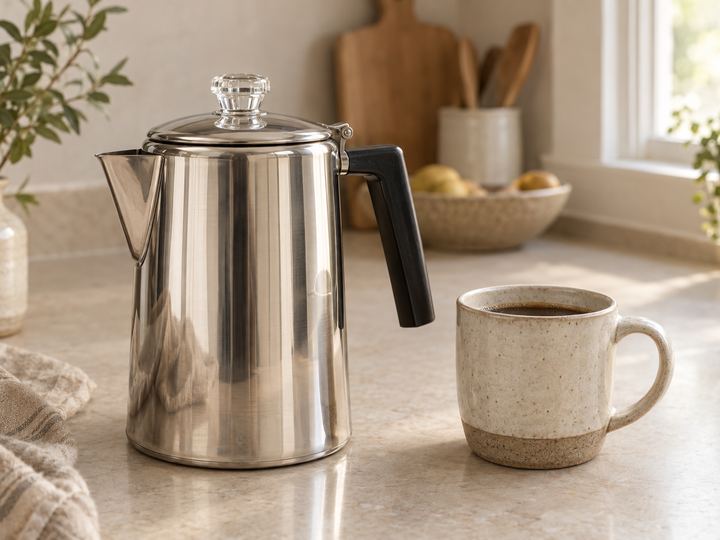
If you're trying to reduce plastic in your daily coffee routine, a stainless steel coffee percolator might be exactly what you need.
Unlike many modern drip coffee makers, which often contain plastic water reservoirs, tubing and filter baskets, traditional percolators use a relatively straightforward brewing system.
Water heats inside the pot, travels upward through a tube and flows over coffee grounds held in a filter basket. This process repeats until the coffee reaches the desired strength.
Many stainless steel percolators use metal pots, brewing tubes and filter baskets, making them attractive alternatives to plastic-heavy coffee machines.
But there's one important thing to understand: not every stainless steel coffee percolator is completely plastic-free.
Some models feature plastic lids, handles or other components, even when the main brewing chamber is stainless steel.
That's why we've put together this comparison of six stainless steel percolators, including electric models from Presto and VEVOR alongside traditional stovetop options from COLETTI and Farberware.
Whether you're looking for an automatic coffee maker, a camping percolator or a simple stovetop option with minimal plastic contact, there's something here worth considering.
Affiliate disclosure: This article contains affiliate links. We may earn a commission from qualifying purchases at no additional cost to you.
Quick Comparison: 6 Stainless Steel Coffee Percolators
| Coffee maker | Type | Capacity | Standout feature |
|---|---|---|---|
| Presto 02811 | Electric | 12 cups | Everyday automatic brewing |
| Presto 02815 | Electric, cordless serving | 12 cups | Detachable serving pot |
| Presto 02822 | Electric | 6 cups | Smaller household capacity |
| COLETTI Bozeman | Stovetop | 9 cups | No plastic or aluminum in the brew path |
| Farberware Yosemite | Stovetop | 12 cups | Classic stainless steel design |
| VEVOR 304 Stainless | Electric | 12 cups | 304 stainless steel inner chamber |
Note: Coffee-maker cup sizes vary by manufacturer and are often smaller than an ordinary mug.
1. Presto 02811 Stainless Steel 12-Cup: Our Favorite Everyday Electric Percolator
The Presto 02811 Stainless Steel Coffee Maker is one of the most straightforward electric percolators to consider if you want the convenience of automatic brewing alongside substantial stainless steel construction.
It features a traditional polished stainless steel exterior that looks at home in almost any kitchen.
More importantly, Presto specifies stainless steel for the grounds basket and percolator tube, two major components that come into direct contact with hot water and coffee.
The 02811 can prepare between two and twelve percolator cups, making it flexible enough for smaller households or larger gatherings.
According to Presto, the machine can brew approximately one cup per minute. Once brewing finishes, an indicator light signals that the coffee is ready, and the appliance automatically keeps the coffee warm.
For people who enjoy strong, traditional coffee but don't want to monitor a pot on the stovetop, this combination of convenience and straightforward design is appealing.
Why we like it
The biggest advantage is simplicity.
Unlike many modern coffee makers, the Presto 02811 doesn't require programmable settings, touchscreen controls, pods or special brewing capsules.
Add water and ground coffee, connect the machine and allow it to complete the brewing cycle.
The metal brewing components also make it an interesting option for shoppers who prefer stainless steel over plastic filter baskets.
However, a stainless steel basket and tube do not prove that every surface contacting water is plastic-free. If complete elimination of plastic is your goal, verify the exact model's full construction before purchasing.
Pros
- Stainless steel grounds basket and percolator tube
- Brews approximately two to twelve cups
- Automatic brewing and warming
- Coffee-ready indicator light
- Classic stainless steel design
- No disposable pods required
Cons
- Requires an electrical outlet
- Not independently verified as completely plastic-free
- Coffee may taste overly strong if the brewing style doesn't suit your preferences
- Attached cord is less convenient for serving than a detachable-base design
Our verdict: The Presto 02811 is an excellent everyday electric percolator candidate for households that want straightforward operation and stainless steel brewing components.
Explore the Presto 02811 stainless steel electric percolator.
2. Presto 02815 Cordless 12-Cup: Ideal for Convenient Serving
If you like the Presto 02811 but want something more convenient for serving coffee, the Presto 02815 Cordless-Serve Coffee Maker deserves a closer look.
Its biggest advantage is the removable power base.
Instead of carrying an electric percolator with an attached cord to the table, you can lift the stainless steel pot off the base and pour coffee directly into everyone's cups.
This small design improvement can make a significant difference at breakfast, during family gatherings or when serving guests.
The Presto 02815 features a stainless steel pot, percolator tube, grounds basket and lid. A glass viewing cover allows you to observe the coffee as it brews.
Its matte-black exterior also gives it a more contemporary appearance than traditional polished stainless steel percolators.
The machine prepares approximately four to twelve percolator cups and automatically keeps coffee warm while it remains on the powered base.
Why we like it
The removable pot makes this model particularly convenient for households where coffee is regularly served away from the kitchen counter.
It also offers many of the features that make electric percolators attractive in the first place, including automatic brewing, a ready indicator light and a reusable brewing basket.
The stainless steel internal components are another advantage for people trying to reduce reliance on plastic equipment.
As with the other electric models, however, confirm the materials of the entire hot-water pathway if you require a completely plastic-free appliance.
Pros
- Removable pot for cord-free serving
- Stainless steel brewing basket, tube and lid
- Glass viewing cover
- Automatic keep-warm function
- Modern matte-black exterior
- Convenient for families and entertaining
Cons
- Generally more expensive than simpler electric percolators
- Requires a powered base for brewing
- Not confirmed to be entirely plastic-free
- Larger capacity may be unnecessary for a single coffee drinker
Our verdict: The Presto 02815 is our preferred choice among these models if serving convenience is more important than minimizing upfront cost.
See the Presto 02815 cordless stainless steel coffee percolator.
3. Presto 02822 6-Cup: A Smart Choice for Smaller Households
Not everyone needs a large coffee pot.
If you're brewing for one or two people, a twelve-cup percolator may take up more space than necessary.
That's where the Presto 02822 6-Cup Stainless Steel Coffee Maker comes in.
This compact electric percolator offers many of the features found in Presto's larger models but with a smaller brewing capacity.
It can prepare approximately two to six percolator cups, making it an attractive choice for individuals, couples or smaller kitchens.
Presto specifies stainless steel for the grounds basket and percolator tube. Like the 02811, the 02822 also includes an indicator light and an automatic keep-warm function.
One thing to remember is that Presto defines a coffee-maker cup as approximately five fluid ounces.
That means six cups equal about 30 fluid ounces, which is closer to two or three larger coffee mugs than six full-size mugs.
Why we like it
The smaller capacity makes this model particularly practical for people who don't regularly prepare coffee for a crowd.
It offers automatic percolator brewing without requiring the counter space associated with larger models.
The reusable stainless steel grounds basket is another appealing feature if you're trying to reduce disposable coffee-making products.
Although its primary brewing components are metal, the complete appliance should not be assumed plastic-free without further confirmation.
Pros
- Smaller size suitable for one or two people
- Two-to-six-cup capacity
- Stainless steel filter basket and percolator tube
- Automatic keep-warm function
- Coffee-ready indicator light
- Simple operation
Cons
- Too small for larger families or gatherings
- No detachable cordless serving base
- Full plastic-free status requires verification
- Stated cup capacity is smaller than standard household mugs
Our verdict: The Presto 02822 is an excellent option if you want a smaller electric percolator without giving up the convenience of automatic brewing.
Take a closer look at the Presto 02822 six-cup coffee maker.
4. COLETTI Bozeman 9-Cup: Our Top Pick for Plastic-Free Stovetop Brewing
For anyone whose main goal is avoiding plastic in the brewing path, the COLETTI Bozeman 9-Cup Percolator stands out from the electric alternatives.
This traditional stovetop coffee maker is designed around a simple idea: use durable materials and keep unnecessary components out of the brewing process.
According to COLETTI, the Bozeman uses 18/8 food-grade stainless steel and contains no plastic or aluminum in the components contacting coffee.
The pot features a glass viewing knob that lets you watch the brewing process, along with a wooden handle on the classic version.
This makes it especially interesting for shoppers who want a stainless steel coffee maker without plastic touching hot water.
Unlike electric percolators, the Bozeman doesn't have an electrical heating system built into the pot.
Instead, it relies on an external heat source, such as a compatible stovetop or camping stove.
The result is a relatively simple brewing system with fewer components to inspect.
Why we like it
The Bozeman's main advantage is its clearly described construction.
Many electric coffee makers advertise stainless steel without specifying all the materials used inside the appliance.
COLETTI, by contrast, explicitly states that there is no plastic or aluminum in the coffee-contact pathway.
The reusable metal basket also eliminates the need for disposable pods.
It's especially appealing for camping, cabin use and households that prefer traditional stovetop brewing.
One thing to check is cooktop compatibility. COLETTI sells a separate induction-compatible Bozeman model, so don't assume that the standard version works on an induction range.
Pros
- No plastic or aluminum in the coffee-contact pathway, according to COLETTI
- Stainless steel construction
- Glass viewing knob
- Suitable for camping and stovetop brewing
- No electricity required
- Reusable filter basket
Cons
- Requires a separate heat source
- Brewing needs more attention than an automatic electric percolator
- Not every version is induction compatible
- Coffee can become bitter if it circulates over the grounds for too long
Our verdict: The COLETTI Bozeman is our leading option in this comparison for buyers who prioritize a manufacturer-described plastic-free brewing path over electric convenience.
Explore the COLETTI Bozeman 9-cup stainless steel percolator.
5. Farberware Yosemite 12-Cup: A Classic Stovetop Percolator
The Farberware Yosemite 12-Cup Coffee Percolator is another attractive option for anyone who appreciates simple, traditional coffee-making equipment.
Farberware has been associated with kitchen cookware for generations, and the Yosemite follows the familiar design of a stainless steel stovetop percolator.
Its heavy-duty stainless steel body is designed for use on compatible stovetops, while the permanent filter basket reduces the need for disposable paper filters.
The Yosemite also features a glass viewing knob, allowing you to see when coffee begins circulating through the brewing system.
Unlike an automatic coffee maker, the Yosemite gives you direct control over heating and brewing time.
That's useful if you enjoy experimenting with stronger or milder percolator coffee.
Its twelve-cup capacity also makes it practical for larger households or preparing coffee for guests.
Why we like it
The Yosemite is appealing because of its relatively uncomplicated design.
It doesn't need electrical power, coffee pods or a separate disposable filter system.
The stainless steel brewing vessel and reusable filter make it worth considering if you're trying to move away from conventional plastic-heavy countertop appliances.
However, the Yosemite has a nonmetal handle and other small components that should be investigated if your requirement is absolutely no plastic anywhere on the appliance.
Farberware also lists the model as unsuitable for induction cooking, so verify compatibility with your stove before ordering.
Pros
- Durable stainless steel body
- Permanent reusable filter basket
- Glass viewing knob
- No electricity required
- Large twelve-cup capacity
- Traditional stovetop brewing experience
Cons
- Requires manual heat control
- Nonmetal components mean it shouldn't be described as entirely plastic-free without qualification
- Not induction compatible according to Farberware's product information
- Can over-extract coffee if left heating too long
Our verdict: The Farberware Yosemite is a practical stovetop choice for buyers who want generous capacity and a traditional stainless steel coffee pot.
Check out the Farberware Yosemite 12-cup stovetop percolator.
6. VEVOR 12-Cup 304 Stainless Steel: A Large Electric Alternative
The VEVOR 12-Cup Electric Percolator offers another option for households that want the convenience of automatic brewing.
Its most interesting feature is the use of 304 stainless steel in the inner brewing chamber.
VEVOR specifies a 1.8-liter capacity, along with a 1,000-watt heating system and an automatic keep-warm function.
The manufacturer also describes internal measurement markings designed to make filling the coffee maker easier.
For people who regularly brew multiple cups at once, the capacity and automatic operation may make this model appealing.
However, there's an important consideration for anyone specifically searching for a no-plastic coffee maker.
VEVOR states that this model contains a plastic lid and other plastic components.
Its specifications also list PCTG and polypropylene in the exterior shell.
Therefore, although the inner chamber uses stainless steel, this model should not be marketed as completely plastic-free.
Why we like it
The VEVOR may suit people who primarily want a stainless steel inner chamber and electric brewing convenience.
Its automatic keep-warm function is useful for households that don't drink all their coffee immediately.
The internal measurement markings are another practical feature.
But if your main priority is eliminating plastic contact with hot water, you should investigate the lid and complete brewing system before choosing this model.
Pros
- 304 stainless steel inner chamber
- Large 1.8-liter capacity
- Electric brewing convenience
- Automatic keep-warm function
- Internal measurement markings
- Reusable brewing system
Cons
- Contains plastic components, including the lid
- Not suitable for shoppers requiring an entirely plastic-free appliance
- Requires electricity
- Bulkier than smaller percolators
Our verdict: The VEVOR is worth considering if you want a large electric coffee maker with a stainless steel interior. However, it's not our recommendation for someone seeking a strictly plastic-free brewing system.
View the VEVOR 12-cup electric stainless steel percolator.
Electric vs. Stovetop Percolators: Which Is Better?
One of the biggest decisions when shopping for a stainless steel coffee percolator is whether to choose an electric model or a stovetop version.
Both can make excellent coffee, but they offer different benefits.
Electric coffee percolators
Electric percolators are designed for convenience.
Many models automatically control the brewing cycle and switch to a warming mode when the coffee is ready.
This makes them useful for busy mornings, offices or households where multiple people drink coffee throughout the day.
Models such as the Presto 02811, 02815 and 02822 are particularly practical if you prefer an appliance that handles most of the brewing process.
The main disadvantage for plastic-conscious buyers is that electrical appliances can contain additional materials around their heating systems, connections and other components.
Stovetop coffee percolators
Stovetop percolators are simpler in construction.
They generally consist of a coffee pot, brewing tube, grounds basket and lid.
Because they don't have built-in electrical heating systems, it can be easier to find models with a clearly defined metal-and-glass brewing path.
The COLETTI Bozeman is a good example.
Stovetop brewing does require more attention, however. You'll need to control the heat and remove the pot at the appropriate time to avoid overly bitter coffee.
Our recommendation
Choose an electric percolator if automatic brewing and convenience matter most.
Choose a stovetop percolator if you prefer a simpler mechanical design, greater portability or more control over the materials contacting your coffee.
How to Choose a Stainless Steel Percolator Without Unnecessary Plastic
1. Inspect the entire brewing path
A stainless steel exterior doesn't necessarily mean a coffee maker is plastic-free.
Check the interior pot, filter basket, percolator tube, lid, seals and any other components that may contact hot water or coffee.
A product advertised as BPA-free can still contain plastic.
If avoiding plastic is your main goal, look for specific manufacturer statements about every relevant component.
2. Consider the type of stainless steel
Food-grade stainless steel is widely used in coffee equipment because of its corrosion resistance and durability.
304 stainless steel, often described as 18/8, is a common option.
316 stainless steel is another suitable grade and offers additional corrosion resistance in some environments, although it isn't automatically necessary for an ordinary coffee maker.
More important than the grade alone is whether the manufacturer clearly identifies the materials used in the brewing system.
3. Choose the right capacity
Percolator capacity can be confusing.
Many manufacturers count a coffee-maker cup as approximately five fluid ounces.
For example:
- A 6-cup percolator may produce around 30 fluid ounces.
- A 9-cup percolator may produce roughly 45 fluid ounces.
- A 12-cup percolator may produce around 60 fluid ounces.
These are illustrative figures, not universal measurements. Check the listed volume for the exact product.
If you usually drink one large mug in the morning, you may not need a twelve-cup model.
4. Think about cleaning
A good percolator should have a removable basket and brewing tube that you can clean thoroughly.
Coffee oils and fine particles gradually accumulate inside the brewing system.
Regular cleaning helps prevent stale flavors and keeps the coffee maker working properly.
Also check whether individual components are dishwasher-safe.
For example, Farberware gives specific cleaning exceptions for parts of the Yosemite percolator.
5. Check stove compatibility
Not all stainless steel stovetop percolators work on induction cooktops.
Induction requires a compatible magnetic base.
If you have an induction range, confirm that the exact percolator model is designed for it.
For gas and electric stovetops, follow the manufacturer's heat-setting instructions.
How to Make Great Coffee in a Stainless Steel Percolator
Even an excellent percolator can produce bitter coffee if it isn't used properly.
The secret is to control extraction and avoid overheating.
Step 1: Start with fresh coffee
Freshly ground coffee generally offers better aroma and flavor than coffee that has been sitting open for weeks.
A medium-coarse grind is a useful starting point for many percolators.
Very fine grounds may pass through the filter basket and create sediment in your cup.
Step 2: Measure your water and coffee
Start with the brewing ratio recommended by your percolator's manufacturer.
If you prefer experimenting, a coffee-to-water ratio around 1:15 to 1:17 by weight can provide a useful initial reference, but percolator brewing may require adjustments for your preferred strength.
Step 3: Add water to the pot
Fill the percolator with the appropriate amount of water.
Never exceed the manufacturer's maximum fill line or operate an electric percolator below its specified minimum.
Step 4: Fill the filter basket
Add ground coffee to the metal basket and assemble the percolator according to its instructions.
Avoid packing the coffee grounds tightly.
Step 5: Begin brewing
For electric models, follow the manufacturer's operating instructions and allow the machine to complete its cycle.
For stovetop models, heat the water until coffee begins circulating, then adjust the heat to maintain a controlled brewing process rather than an aggressive boil.
Step 6: Stop brewing at the right time
Stovetop percolators require particular attention because coffee repeatedly cycles through the grounds.
If you continue percolating for too long, the coffee can become harsh or bitter.
Start with a moderate brewing time and adjust according to your taste and the manufacturer's instructions.
Step 7: Serve promptly
For the freshest flavor, serve your coffee soon after brewing.
If you're not drinking it immediately, transferring it to an insulated serving carafe can help maintain temperature without continued heating.
Frequently Asked Questions
Are stainless steel coffee percolators completely plastic-free?
Not necessarily.
Many have stainless steel pots and filter baskets but may also include plastic handles, lids, seals or other components.
For a clearly described plastic-free coffee-contact pathway, the COLETTI Bozeman is one of the more compelling options in this roundup.
Is a stainless steel percolator better than a regular drip coffee maker?
It depends on the kind of coffee you enjoy.
Percolators repeatedly circulate water through coffee grounds, producing a strong, traditional brew.
Automatic drip machines typically pass water through the grounds once, often resulting in a different flavor profile.
Neither brewing method is inherently better for everyone.
Do stainless steel percolators require paper filters?
Many models include reusable metal filter baskets, so disposable paper filters aren't always necessary.
However, some coffee drinkers use optional paper filters to reduce sediment and make cleanup easier.
Always choose filters compatible with your specific model.
Can you use a stainless steel percolator on an induction stove?
Some models are induction-compatible, but not all.
COLETTI makes a separate induction-compatible Bozeman version. The standard model should not be assumed suitable.
Similarly, Farberware lists the Yosemite as not induction-compatible.
Always check the exact model before purchasing.
Is percolator coffee stronger than drip coffee?
Percolator coffee often tastes stronger because hot water repeatedly passes through the grounds.
However, actual beverage strength and caffeine content depend on the coffee dose, water quantity, brewing time and extraction.
A stronger taste doesn't automatically mean more caffeine.
What is the difference between the Presto 02811 and 02815?
Both are twelve-cup electric percolators with stainless steel brewing components.
The main difference is that the Presto 02815 has a removable pot and power base for cordless serving.
The 02811 uses a more traditional attached-cord design.
Which coffee percolator is easiest to use?
For automatic brewing, the Presto electric models are convenient options.
For a simple stovetop setup without built-in electronics, the COLETTI Bozeman and Farberware Yosemite are worth considering.
Final Verdict: Which Stainless Steel Coffee Percolator Should You Buy?
There isn't one perfect percolator for everyone.
The right choice depends on whether you prioritize electric convenience, capacity, stovetop brewing or minimizing plastic contact.
Our recommendations:
- For everyday electric brewing: Presto 02811. A traditional stainless steel electric percolator with automatic brewing and warming.
- For convenient serving: Presto 02815. The removable power base makes it especially practical for breakfast tables and entertaining.
- For one or two coffee drinkers: Presto 02822. A smaller six-cup option with the familiar Presto brewing system.
- For minimizing plastic contact: COLETTI Bozeman. The manufacturer specifically describes a stainless steel brewing path without plastic or aluminum.
- For classic stovetop brewing: Farberware Yosemite. A traditional stainless steel pot with a generous capacity and reusable filter basket.
- For a large electric alternative: VEVOR 12-Cup. Offers a 304 stainless steel inner chamber, though it contains plastic components.
If your goal is to reduce plastic contact with hot coffee as much as possible, the COLETTI Bozeman is our standout stovetop recommendation from these six models.
If you prefer an electric coffee maker, the Presto 02811 is an appealing alternative, provided its materials meet your particular requirements.
Ultimately, buying a coffee maker with less plastic isn't just about choosing a stainless steel exterior.
It's about understanding which materials come into contact with your water and coffee, how the machine works and whether its design suits your daily routine.
With the right stainless steel percolator, you can enjoy rich, traditional coffee using a durable brewing system for years to come.